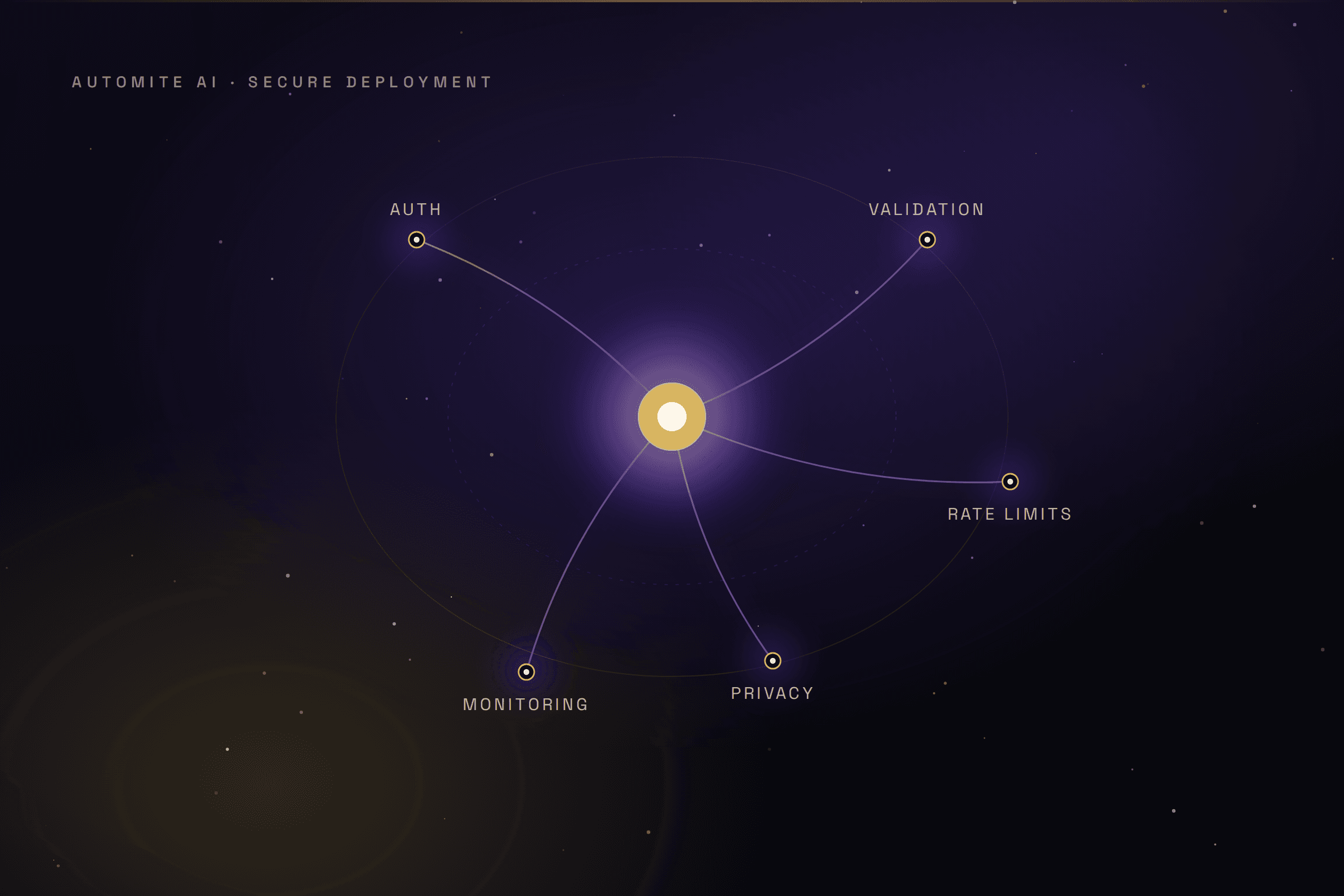
Okay, this is genuinely exciting — let me show you why. You just built a voice agent that answers calls, books meetings, and pulls live data from your systems. It sounds like a person, it thinks on its feet, and it's ready to go live. So let's talk about the part nobody puts on the demo reel: shipping it safely. Because here's the thing — deploying a voice agent to production isn't scarier than deploying any other API-backed service. It just has a few extra doors you need to lock, and once you know which ones, it's genuinely fast to get right.
Start with the front door: authentication. Your voice agent almost certainly needs to reach real systems — a calendar, a CRM, an order database — and that means it's holding credentials. Never let the agent hold long-lived, all-powerful keys. Give it scoped tokens tied to the specific actions it's allowed to take, and rotate them like you would for any service account. If your agent is taking calls from the public phone network, treat every inbound call as untrusted until proven otherwise — verify caller ID where you can, and for anything sensitive, layer in a real verification step, like a PIN or an account lookup, before the agent will touch account data. The agent's job is to be warm and helpful on the surface; underneath, it should be as suspicious as any other backend service.
Now the part that trips people up the most: input validation. A voice agent doesn't get clean JSON from a form field — it gets a live, messy transcript from a speech-to-text model, and that transcript gets handed to an LLM that's deciding what tool to call next. That's two layers of interpretation between "what the caller said" and "what your system does," and both layers can be nudged. Someone could try to talk your agent into ignoring its instructions, or slip a prompt injection into what sounds like an innocent request. The fix isn't to be paranoid about your users — it's to be disciplined about your architecture. Keep a hard boundary between what the model decides and what your tools are allowed to execute. Validate every parameter a tool receives, the same way you'd validate an API request from a stranger on the internet, because that's functionally what it is. If a tool call says "transfer five thousand dollars" or "delete this record," that's exactly the kind of action that should require a second layer of confirmation outside the model's judgment, not just a well-phrased system prompt telling it to be careful.
Here's a small thing that makes a big difference: rate limiting. Voice agents are conversational, which means a bad actor — or just a runaway loop in your own orchestration — can hammer your backend with tool calls far faster than a human ever would in a real conversation. Put limits at every layer: per-call, per-caller, and per-tool. Cap how many times the agent can call your CRM in a single conversation. Cap how many calls a single phone number can start in an hour. This isn't just about cost control, although it absolutely helps there too — it's about making sure one weird conversation can't turn into a denial-of-service against your own systems.
Data privacy is the one that deserves real respect, because voice is personal in a way text isn't. People say things on a call they'd never type into a chat box — account numbers, health details, their kid's school. So treat call transcripts and recordings like the sensitive data they are. Encrypt them at rest, encrypt them in transit, and be deliberate about retention — don't keep full transcripts forever just because storage is cheap. If you're in a regulated space, redact or mask sensitive fields before they ever hit your logs or your analytics dashboard. And if you're recording calls, say so, clearly, at the start of the conversation. It's the law in a lot of places, and honestly, it's just the right thing to do — trust is the whole product when you're asking someone to talk to a machine.
Let's wire up the production side. Log everything the agent does — not the raw audio necessarily, but every tool call, every decision point, every escalation to a human. When something goes sideways at 2am, you want a clear trail: what did the caller ask, what did the model decide, what did the tool actually execute. Put your voice agent behind the same monitoring discipline you'd apply to any critical service — alerts on error rate spikes, alerts on unusual tool-call patterns, a dashboard that tells you at a glance whether today looks like a normal day. And always, always build the escape hatch: a clean way for the agent to say "let me get a person for you" and hand off gracefully, with the context carried over so the caller never has to repeat themselves. That's not a failure state — that's good design.
Here's the honest gotcha, flagged cheerfully because it's genuinely not a big deal once you know it: none of this is exotic. It's the same production discipline you'd apply to any API-facing service — scoped auth, validated inputs, rate limits, encrypted data, real logging — just applied to a channel that happens to be a phone call instead of an HTTP request. The voice part is the exciting new capability. The security part is just good engineering, and you probably already know how to do most of it.
The best part? You can build this today. Take the voice agent you've already got running, and this week, do one pass through it with this checklist: scope down its credentials, put a validation layer between the model's tool calls and your actual systems, add a rate limit on the loudest tool it calls, and check that your transcript storage has an expiration date on it. That's an afternoon of work, and it's the difference between a demo and a production system you can actually trust with real callers. Agents are only as good as the tools you give them — and a secure deployment is just one more tool in the kit. Go wire it up.