I once spent a Friday afternoon debugging why our voice agent kept answering the wrong question. Turned out the customer said "I need to cancel my subscription, not upgrade it" and our speech-to-text model heard "I need to cancel my subscription. Not. Upgrade it." Two sentences. A period where there should've been a comma. By the time that transcript hit the language model, the emphasis, the slight edge of frustration in the customer's voice, all of it was gone. The LLM saw flat text and answered a flat question. The agent cheerfully tried to upgrade the guy's plan. He hung up. I don't blame him.
That's the tax you pay with cascaded voice agents, and until recently, everyone paid it, because there wasn't another option.
Here's how the old pipeline works, in case you haven't had the pleasure. Someone talks. A speech-to-text model listens and spits out a transcript. That transcript gets handed to a language model, which has never heard a human voice in its life — it only ever sees words on a page. The LLM writes a reply. A text-to-speech model reads that reply out loud in a voice that was never present for the conversation. Three separate models, three separate jobs, stitched together with the digital equivalent of duct tape and good intentions. It's the audio version of a game of telephone, except instead of drunk relatives at Christmas, it's a customer service call and someone's cable bill.
The thing nobody tells you about this setup is that the STT layer isn't just transcribing, it's throwing things away. Tone. Pace. The little intake of breath before someone says "actually, wait." Sarcasm, which lives entirely in how something is said and almost never in what's said. All of that gets flattened into ASCII text before the model that's supposed to respond intelligently ever gets a look at it. You're asking your LLM to be emotionally intelligent while feeding it a transcript with the emotional intelligence surgically removed. That's not a fair fight.
And then there's latency, which is its own special kind of pain. Every hop between models costs time — audio in, text out, text in, response out, text in, audio out. Each stage has its own processing delay, and they stack. That's why so many voice bots have that half-second "is it thinking or did it die" pause that trains callers to just start talking over the bot, which then confuses the bot, which then apologizes and asks you to repeat yourself. In theory, this works. In practice, you have a support ticket titled "the AI keeps interrupting itself."
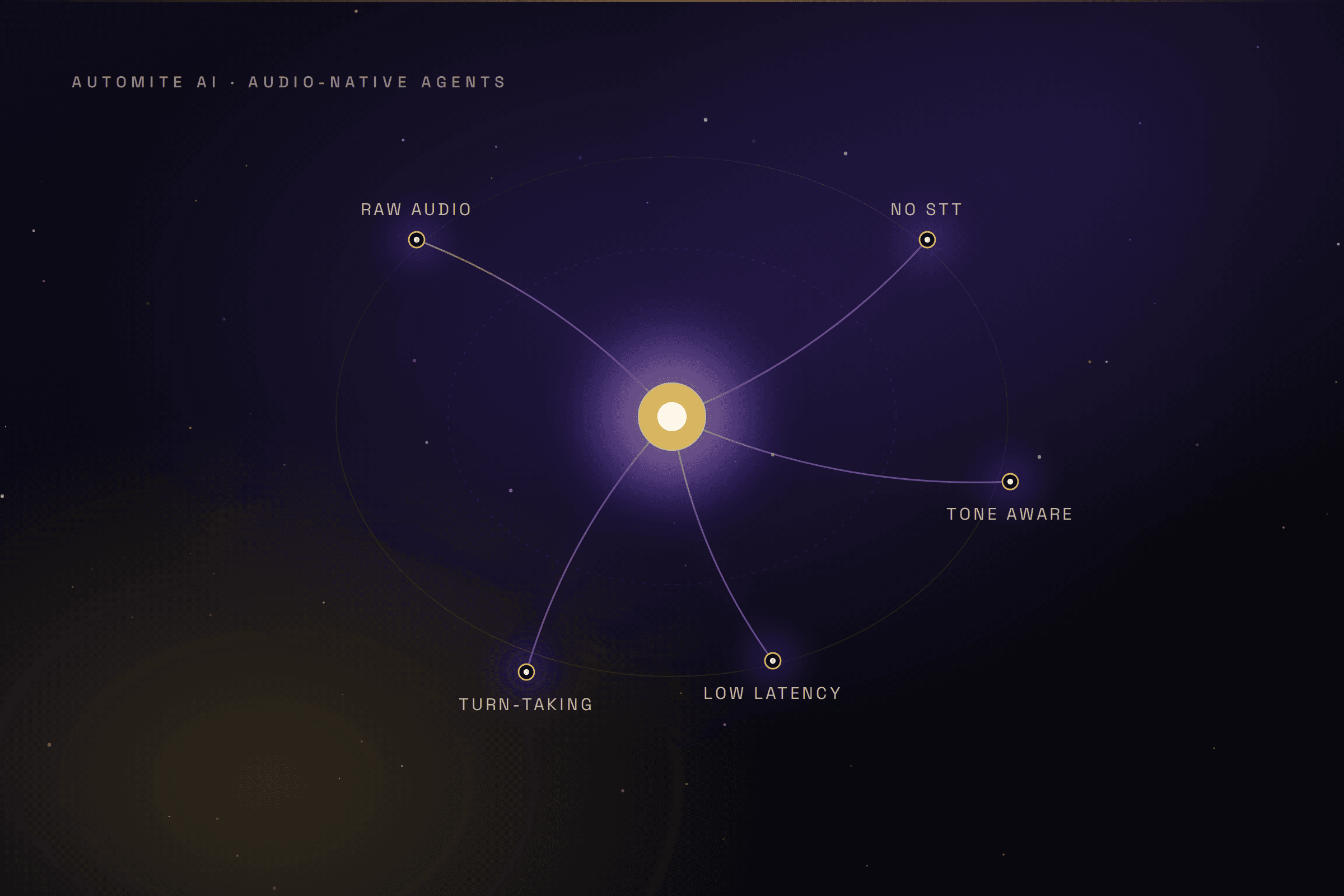
So here's the actual news: newer models skip the transcription step entirely. They take raw audio in and generate audio out, natively, as one continuous process. No text bottleneck in the middle. The model that's deciding what to say is the same model that heard how you said the last thing, tone and timing included. It's a genuinely different architecture, not just a faster version of the old one.
Why does this matter beyond "cool, new model shape"? A few concrete reasons.
Latency drops hard, because you've cut out two full model-to-model handoffs. Speaking to a voice-native model can feel closer to talking to a person than talking to a phone tree, and that difference is very noticeable the moment it's gone — it's the sort of thing you don't consciously register until a call feels off.
Prosody survives. If someone sounds annoyed, worried, or in a hurry, the model actually has access to that signal when forming a response, instead of getting handed a transcript that reads exactly the same whether the customer was calm or furious. That's a real capability, not a parlor trick — it changes how the response gets shaped, not just how it sounds.
Error cascades shrink. In the old pipeline, a bad transcription poisons everything downstream — the LLM confidently reasons about a sentence that was never actually said, and the TTS model reads out the confident wrong answer in a pleasant voice, which somehow makes it worse. Skip the transcription step and you remove an entire category of "the system was very sure about something nobody actually said."
Turn-taking gets more natural. Interruptions, the little "mm-hmm" backchannels people make while listening, someone trailing off mid-sentence and picking it back up — a model that's reasoning in continuous audio can handle these the way a person does, roughly, instead of treating every pause as a hard stop signal or ignoring interruptions because it's still waiting for a clean sentence boundary.
Now, the honest part, because I'd rather tell you where this breaks than let you find out on a client call. This stuff is still maturing. Latency is better, not solved — you're still shipping audio over a network, and networks have opinions. Fine-grained control over what the agent says is harder than with a text-based pipeline, because you can't as easily inspect and edit a transcript before it goes out; you're steering behavior through audio-in, audio-out, which is a less legible surface to debug. Tooling and observability are behind where they are for text agents — when a voice-native model gives a weird answer, you don't get a clean transcript to stare at and go "ah, there's the bug," you get a waveform and a hunch. And cost per minute is still real money at scale, more than most teams expect going in.
None of that means skip it. It means treat it like what it is: a genuinely better architecture for the problem, deployed carefully, with fallbacks, and with someone watching the bill.
If you're running a cascaded voice agent right now and it's misreading tone or lagging on turn-taking, don't wait for a full rebuild to see the difference. Take one narrow flow — appointment confirmations, a returns line, whatever gets the highest call volume with the lowest complexity — and run it through a voice-native model in parallel for a week. Compare the transcripts your customers would've hated against the calls that actually went fine. You'll know within a few dozen calls whether the tax you've been paying on the old pipeline is worth still paying.